Clinical need

The operation a child gets depends on how far the tools can reach.

In craniosynostosis a suture fuses too early. The fix is surgical: cut the bone, release the suture, let the brain grow. How much bone a surgeon can reach through a small incision decides which operation.

age at corrective craniosynostosis surgery
2–12months
age at corrective craniosynostosis surgery
CIHR grant
thickness of the infant calvarium
~2mm
thickness of the infant calvarium
CIHR grant
molding helmet worn after endoscopic repair (~$4,200)
6–12months
molding helmet worn after endoscopic repair (~$4,200)
CIHR grant

Open vs. endoscopic

Extensive reshaping, or a small incision. Not both.

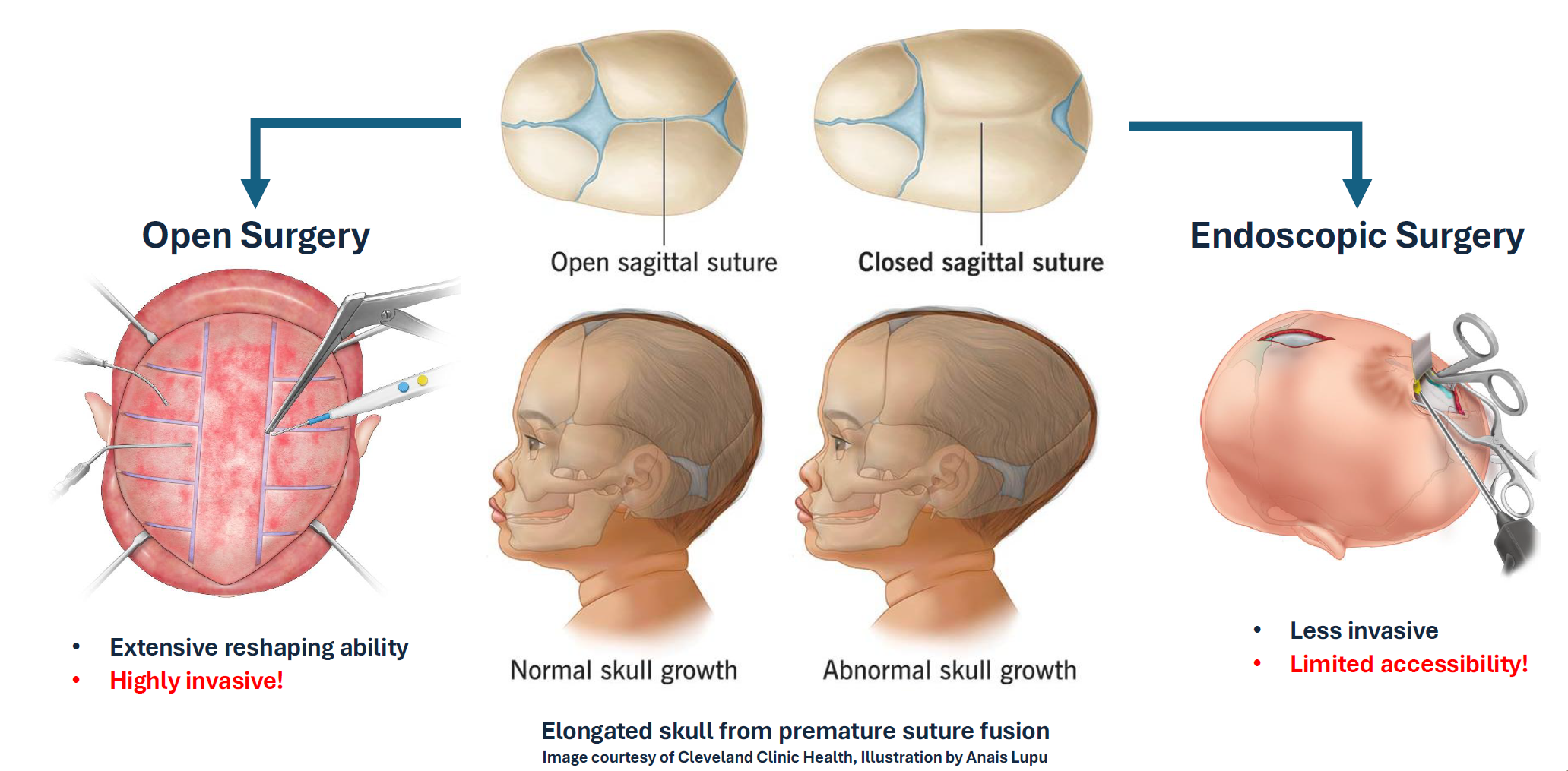
Open surgery reshapes the vault but is highly invasive. Endoscopic surgery is minimally invasive but limited in what it can reach. Ossentra is built to close that gap.

Craniosynostosis surgery: open vs. endoscopic approach
Open surgery vs. endoscopic surgery for craniosynostosis.
How the limit propagates

The instruments are straight. The skull is not.

Endoscopic repair uses straight, rigid tools through a small incision. None follow the curve of an infant's vault, so surgeons work blind or add another incision.

The tool sets the osteotomy, not the plan.

Cuts are limited by what the instruments can reach. Late-presenting and multi-suture cases go to open surgery, which means a large incision, more blood loss, and a longer stay.

The child carries the difference.

Open surgery risks blood loss up to 500% of total blood volume. Endoscopic repair leaves a helmet worn 6–12 months. The less a surgeon can cut, the more is left for after.

Open surgery vs. Ossentra

What changes for the infant.

83% → ~10%
Blood transfusion rate drops about ninefold, which is life-altering for a 3-month-old
95%
Less tissue trauma than a full craniotomy, with no reshaping of the whole vault
40–50%
Less OR time; ICU recovery from 3 days to 1
References
  1. [1]Law J, et al. A Novel Articulating Bone Cutting Tool for Minimally Invasive Craniosynostosis Surgery. ASME Journal of Medical Devices, 2025.
  2. [2]Podolsky D, et al. Development of a minimally invasive bone cutting tool for craniosynostosis surgery. CIHR Project Grant.
  3. [3]Cable-driven continuum mechanism. Patent WO2024156054A1, filed 2024, licensed to Ossentra.