Powered, faster cutting
A manual punch is slow. A powered bone-cutting mechanism is the next end-effector.

Technology
Flexible instruments go slack against bone. Powered benders are built for hips and shoulders. An infant's skull is 2 mm of bone over dura. It needs a different instrument.
Investigational device. Bench-stage prototype, not cleared for clinical use. Advancing toward FDA Class II 510(k).
The end-effector
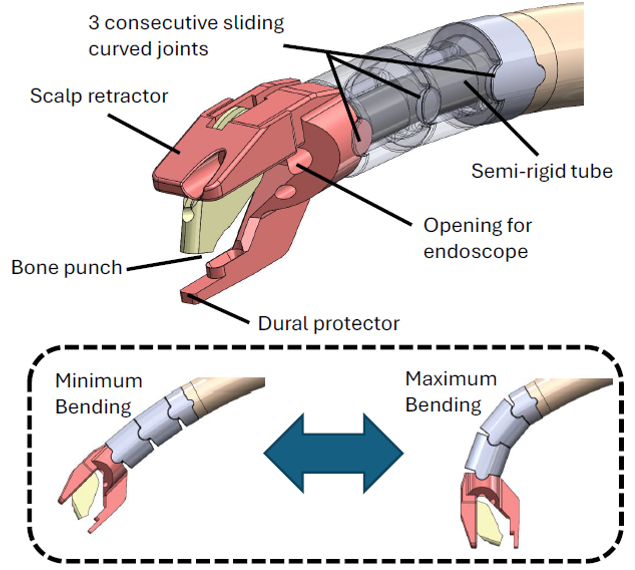
A cable-driven bone punch. The lower jaw is the dural protector, staying between the punch and the dura through every bite. A scalp retractor above makes the pocket the endoscope sees into.
Punch, dural protector, and endoscope channel all fit in one 13 mm shaft. Protection isn't a setting the surgeon turns on. It comes from the shape of the jaw.
Articulation
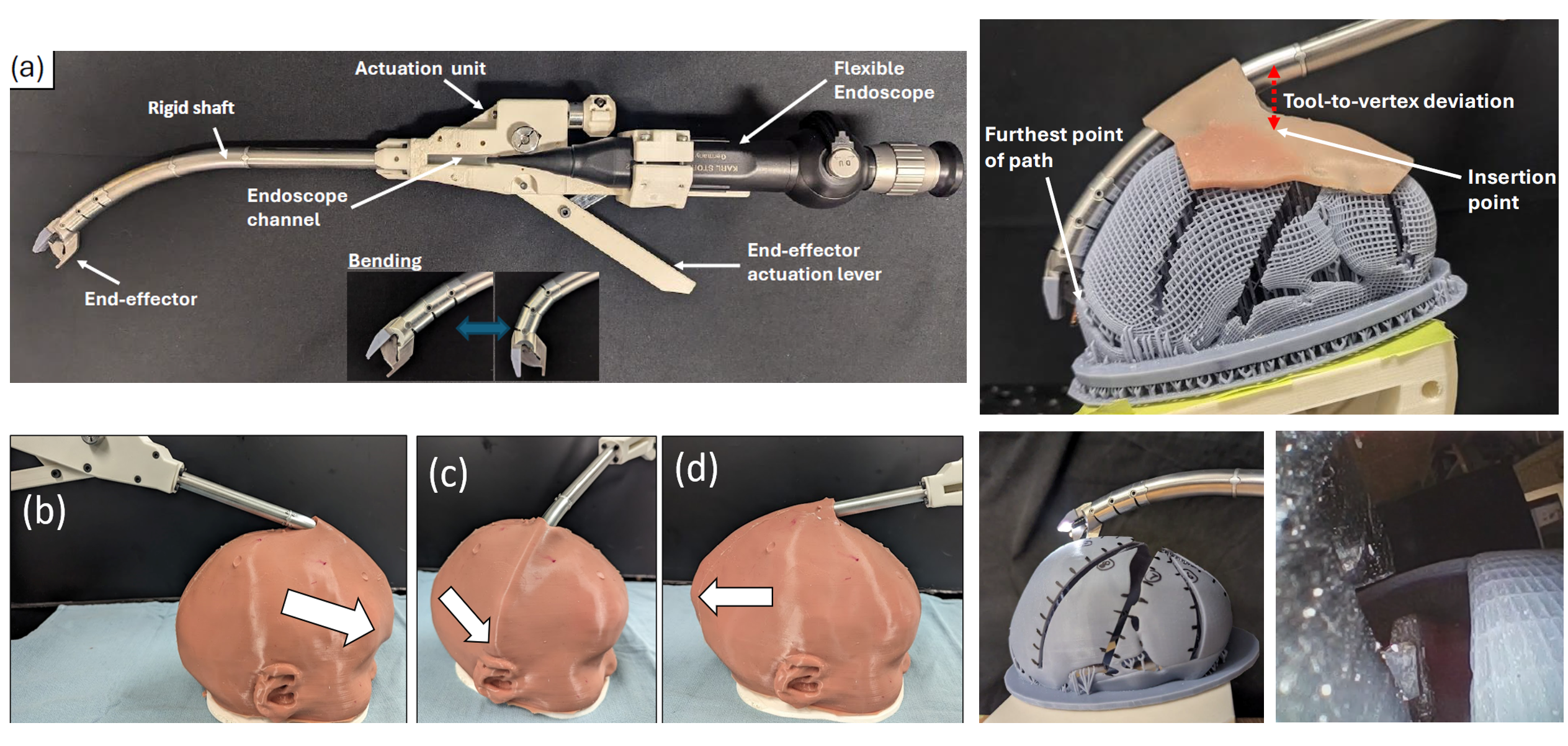
A cable-driven bending section conforms to the ~140 mm curvature of the infant cranium. A worm-gear drive holds the angle without power and without back-driving.
One shaft and one vertex incision reach where straight tools work blind or need a second cut.
| Test | Result | Conditions |
|---|---|---|
| Tip deflection | 3.6 mm at 10 N (0° bending) | Stiffness of the bending section under external load. |
| Workspace | 23.7 mm reach · 120° sweep | Kinematic analysis of the tool tip about a fixed incision point. |
| Cutting force | < 40 N cable tension | Cutting 2 mm PCF 30 & 40 polyurethane bone analogue. |
| Bending range | Segment 1: 60° · Segment 2: 90° | Two-segment tendon-driven articulation, variable stiffness. |
| Shaft | 13 mm diameter | Bone punch jaws, dural protector, and endoscope channel in one shaft. |
Law J, et al. A Novel Articulating Bone Cutting Tool for Minimally Invasive Craniosynostosis Surgery. ASME Journal of Medical Devices, 2025. Patent WO2024156054A1.
Robot-ready
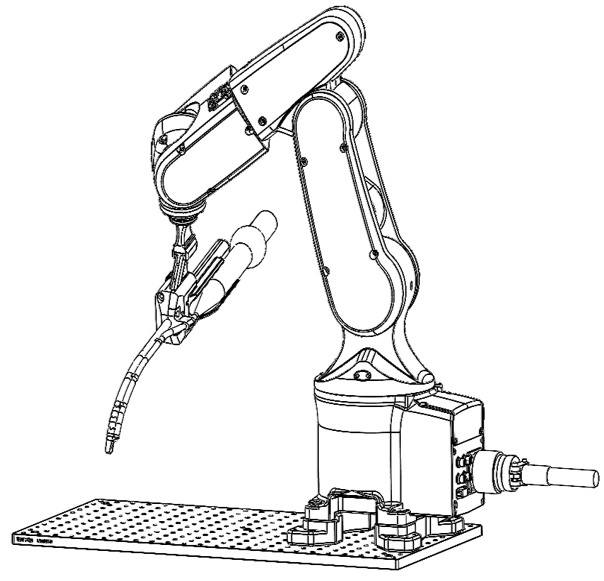
The cable-driven mechanism is the class used in leading surgical robots. It is manual today, and the same architecture mounts as an end-effector on a robotic arm with no redesign. Only the drive needs motorizing.
What's next
The functions between a proven concept and a real osteotomy.
A manual punch is slow. A powered bone-cutting mechanism is the next end-effector.
Bone bleeds the moment you cut it. Two more channels clear the field for the endoscope.
The dural protector, scalp retractor and suction tip double as cautery.